You’ve heard the word ten thousand times. On the back of every packet. In every diet video. From every uncle with an opinion. “Too many calories.” “Burn the calories.” “This has no calories.”
But if I stopped you right now and asked — what is a calorie, actually? — most people can’t answer. And that’s not your fault. Nobody ever explained it. They just started using the word around you and assumed you’d pick it up.
So let’s fix that. One concept, explained properly. No math you have to do, no app you have to download. Just the thing itself.
Name it, then define it
A calorie is a unit of energy. That’s it. That’s the whole word.
It’s a measurement, the same way a kilometre measures distance and a litre measures volume. A calorie measures energy — specifically, how much energy your body can pull out of a food when it breaks it down.
So when a packet says “250 calories,” it’s not telling you how bad the food is. It’s telling you how much energy is in it. A high number isn’t a moral failing. It’s just more fuel.
A calorie isn’t a moral score. A high number just means more fuel.
(One small technical note so you’re never confused: the “calories” on a food label are technically kilocalories — kcal. You’ll see “kcal” and “calories” used to mean the same thing on Indian packets. Don’t worry about it. Everyone, including me, just says “calories.”)
Here’s how it actually works
Your body is running an engine every single second — even right now, sitting still, reading this.
Your heart is pumping. Your lungs are moving. Your brain is using a surprising amount of energy just to exist. You’re keeping yourself warm. All of that costs energy, and you’re spending it even in your sleep. That’s energy out.
Where does that energy come from? Food and drink. Everything you eat and drink that contains energy is energy in.
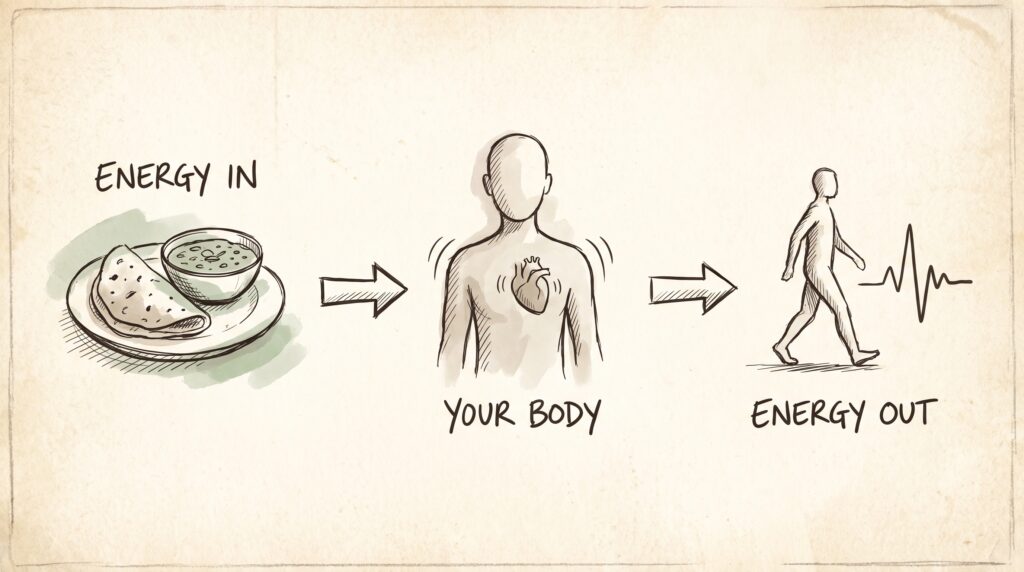
That’s the entire system:
- Energy in — the food and drink you take on
- Energy out — everything your body does with it, all day, including doing nothing
A calorie is just the unit we use to measure both sides of that exchange. It lets you compare a roti and a run on the same scale.
Why this one word matters so much
Because the gap between energy in and energy out, over time, is what moves your weight. Nothing mystical. Just the gap.
- Take in more energy than you spend, day after day → your body stores the extra (mostly as fat).
- Take in less than you spend → your body pulls the difference from its stores → you lose weight.
- Take in about the same → you hold steady.
That’s why a calorie is worth understanding before anything else in nutrition. Keto, intermittent fasting, “clean eating,” that expensive powder your gym is selling — every single approach that changes your weight is, underneath the branding, changing this gap. Once you see that, you stop falling for the packaging.
Two things people get wrong (so you don’t)
“This food has no calories.” Almost nothing you’d call food is truly calorie-free. Water, plain black coffee, and plain green tea are basically zero — but the moment you add sugar, milk, or oil, energy comes with it. And “negative calorie” foods — the idea that chewing celery burns more than it gives — are a myth. The effect rounds to nothing.
“Calories are bad.” Calories aren’t bad. Calories are life. You would die without them — they’re the fuel your body runs on. The goal is never zero calories. It’s roughly the right amount for you, from food that also does other good things for you.
Honest notes
A calorie tells you about energy, and energy decides the direction your weight moves. But it tells you nothing about the other things that matter:
- How full you feel. 200 calories of dal keeps you full for hours. 200 calories of soft drink keeps you full for about four minutes.
- What your body builds. 200 calories of protein and 200 of sugar move your weight the same way, but do very different things for your muscle, recovery, and mood.
- Your health. Vitamins, minerals, and fibre don’t show up in the calorie number at all — and they run the show behind the scenes.
So the honest version: calories decide which direction your weight goes; the type of food decides how you feel getting there, and what your body is made of when you arrive. Anyone who tells you only calories matter, or that calories don’t matter, is selling you half the picture. We’ll unpack the “type of food” side in the next post — that’s what macros are.
So what do you do with this?
Almost nothing, at first — and that’s the point. You don’t need to start counting every roti today. Counting comes much later, and only as a short teaching tool. For now, all you need is the mental model:
- Everything you eat and drink carries energy in — including drinks, especially the sweet ones.
- Your body spends energy out all day, whether you train or not.
- If your weight is drifting, the gap between those two is why — not your “slow metabolism,” not one bad meal.
Carry that one idea around for a week and you’ll already read food — and diet advice — differently. When you’re ready to put a rough number on your own “energy out,” the calorie calculator on the tools page estimates it in about thirty seconds. But you don’t need it to understand the concept. The concept came first for a reason.

Responses
No responses yet — be the first to leave a note.